1960 Mens Fashion How Many Hairstyles Were Famous in the 1960s
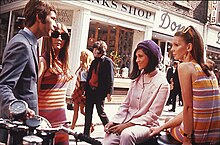

Way of the 1960s featured a number of diverse trends. It was a decade that broke many style traditions, mirroring social movements during the time. Around the middle of the decade, fashions arising from modest pockets of young people in a few urban centers received large amounts of media publicity, and began to heavily influence both the haute couture of elite designers and the mass-market place manufacturers. Examples include the mini brim, culottes, become-become boots, and more experimental fashions, less often seen on the street, such every bit curved PVC dresses and other PVC clothes.
Mary Quant popularized the mini skirt, and Jackie Kennedy introduced the pillbox chapeau;[1] both became extremely pop. Imitation eyelashes were worn by women throughout the 1960s. Hairstyles were a variety of lengths and styles.[2] Psychedelic prints, neon colors, and mismatched patterns were in style.[3]

In the early-to-mid 1960s, London "Modernists" known every bit Mods influenced male person style in Britain.[4] Designers were producing clothing more suitable for young adults, which led to an increase in interest and sales.[5] In the late 1960s, the hippie move also exerted a strong influence on women'southward clothing styles, including bong-lesser jeans, tie-dye and batik fabrics, as well as paisley prints.
Women's manner [edit]
Early 1960s (1960–1962) [edit]
High fashion [edit]
American fashions in the early years of the decade reflected the elegance of the Commencement Lady, Jacqueline Kennedy. In addition to tailored skirts, women wore stiletto heel shoes and suits with short boxy jackets, and oversized buttons. Uncomplicated, geometric dresses, known equally shifts, were also in style. For evening wear, total-skirted evening gowns were worn; these often had low necklines and close-fitting waists. For coincidental wear, capri trousers were the fashion for women and girls.[ citation needed ]
Bikini [edit]

The bikini, named afterwards the nuclear exam site on Bikini Atoll, was invented in France in 1946 only struggled to gain credence in the mass-marketplace during the 1950s, especially in America. The quantum came in 1963, after rather large versions featured in the surprise hit teen motion-picture show Embankment Political party, which launched the Embankment party film genre.
The rise of trousers for women [edit]

The 1960s were an historic period of fashion innovation for women. The early on 1960s gave nascence to drainpipe jeans and capri pants, which were worn by Audrey Hepburn.[vi] Casual dress became more unisex and often consisted of plaid push downwards shirts worn with slim blue jeans, comfortable slacks, or skirts. Traditionally, trousers had been viewed by western guild as masculine, but by the early 1960s, it had become acceptable for women to clothing them every day. These included Levi Strauss jeans, which had previously been considered blue neckband article of clothing, and "stretch" drainpipe jeans with elastane.[7] Women's trousers came in a variety of styles: narrow, wide, beneath the knee joint, above the ankle, and eventually mid thigh. Mid-thigh cutting trousers, besides known as shorts, evolved around 1969. By adapting men's mode and wearing trousers, women voiced their equality to men.[8]
Mid 1960s (1963–1966) [edit]
Space Age fashions [edit]

Space age style showtime appeared in the late 1950s, and developed further in the 1960s. It was heavily influenced past the Space Race of the Common cold War, in addition to pop science fiction paperbacks, films and television series such equally Star Trek: The Original Series, Dan Cartel, or Lost In Space. Designers often emphasized the energy and technology advancements of the Cold War era in their work.[9]
The infinite historic period look was divers by boxy shapes, thigh length hemlines and bold accessories. Synthetic material was also pop with space age fashion designers. Subsequently the Second Globe War, fabrics similar nylon, corfam, orlon, terylene, lurex and spandex were promoted as cheap, like shooting fish in a barrel to dry, and wrinkle-free. The constructed fabrics of the 1960s immune space age fashion designers such as the late Pierre Cardin to design garments with bold shapes and a plastic texture.[10] Not-cloth material, such as polyester and PVC, became popular in clothing and accessories likewise. For daytime outerwear, brusk plastic raincoats, colourful swing coats, bubble dresses, helmet-like hats, and dyed fake-furs were pop for young women.[xi] In 1966, the Nehru jacket arrived on the style scene, and was worn by both sexes. Suits were very diverse in colour but were, for the first fourth dimension ever, fitted and very slim. Waistlines for women were left unmarked and hemlines were getting shorter and shorter.
Footwear for women included low-heeled sandals and kitten-heeled pumps, every bit well as the trendy white go-go boots. Shoes, boots, and handbags were frequently made of patent leather or vinyl.[ commendation needed ] The Beatles wore rubberband-sided boots similar to Winkle-pickers with pointed toes and Cuban heels. These were known every bit "Beatle boots" and were widely copied by young men in Britain.
The French designer André Courrèges was particularly influential in the development of space age fashion. The "infinite look" he introduced in the spring of 1964 included trouser suits, goggles, box-shaped dresses with high skirts, and get-go boots. Become-get boots eventually became a staple of become-become daughter manner in the 1960s.[12] The boots were defined by their fluorescent colors, shiny material, and sequins.[13]
Other influential space age designers included Pierre Cardin, Paco Rabanne, Rudi Gernreich,[fourteen] Emanuel Ungaro, Jean-Marie Armand,[15] and Diana Dew, though fifty-fifty designers like Yves Saint Laurent[16] [17] [xviii] [19] showed the look during its peak of influence from 1963-1967.[twenty] [21] Italian-born Pierre Cardin[22] was best known for his helmets, brusk tunics, and goggles.[22] Paco Rabanne was known for his 1966 "12 Unwearable Dresses in Contemporary Materials" collection,[nine] which made use of chain mail, aluminum, and plastic.[23]
A timeless fashion piece: miniskirt [edit]

German language girl wearing a mini-skirt in Greece, 1962.
Although designer Mary Quant is credited with introducing the mini-skirt in 1964, André Courrèges also claimed credit for inventing the mini-skirt. The miniskirt inverse fashion forever.
The definition of a miniskirt is a skirt with a hemline that is more often than not between 6 and 7 inches above the knees. Early references to the miniskirt from the Wyoming newspaper The Billings Gazette, described the miniskirt every bit a controversial item that was produced in United mexican states Metropolis.[ commendation needed ] During the 1950s, the miniskirt began actualization in science fiction films like Flight to Mars and Forbidden Planet [24]
Mary Quant and Andre Courreges both contributed to the invention of the mini-skirt during the 1960s. Mary Quant, A British designer, was i of the pioneers of the miniskirt during 1960. She named the brim later on her favorite car, the Mini Cooper. Quant introduced her design in the mid 1960s at her London boutique, Bazaar. She has said: " We wanted to increment the availability of fun for everyone. Nosotros felt that expensive things were almost immoral and the New Await was totally irrelevant to usa." Miniskirts became popular in London and Paris and the term "Chelsea Look" was coined.[25]
Andre Courreges was a French fashion designer who besides began experimenting with hemlines in the early 1960s. He started to show space-age dresses that hitting above the knee in late 1964. His designs were more structured and sophisticated than Quant's design.[ commendation needed ] This made the miniskirt more acceptable to the French public. His clothes represented a couture version of the "Youthquake" street way and heralded the arrival of the "moon girl" look.[26]
As teen culture became stronger, the term "Youthquake" came to mean the power of young people. This was unprecedented earlier the 1960s. Before World War Ii, teenagers dressed and acted similar their parents. Many settled down and began raising families when they were young, normally right later on high school. They were frequently expected to work and aid their families financially. Therefore, youth civilization begins to develop only afterwards Earth War II, when the advancement of many technologies and stricter child labor laws became mainstream. Teenagers during this catamenia had more time to enjoy their youth, and the freedom to create their own culture separate from their parents. Teens soon began establishing their own identities and communities, with their own views and ideas, breaking away from the traditions of their parents.[27] The fabled "little girl" look was introduced to USA—styling with Bobbie Brooks, bows, patterned articulatio genus socks and mini skirts. The miniskirt and the "little girl" wait that accompanied it reverberate a revolutionary shift in the way people dress. Instead of younger generations dressing like adults, they became inspired by childlike apparel.[28]
2nd-wave feminism made the mini-skirt pop. Women had entered the professional workforce in larger numbers during World War II and many women soon found they craved a career and life outside the home.[29] They wanted the same choices, freedoms, and opportunities that were offered to men.[30]
During the mid 1960s, Mod girls wore very short miniskirts, tall, brightly colored go-go boots, monochromatic geometric print patterns such as houndstooth, and tight fitted, sleeveless tunics. Flared trousers and bell bottoms appeared in 1964 equally an culling to capri pants, and led the manner to the hippie menstruum introduced in the 1960s. Bell bottoms were unremarkably worn with chiffon blouses, polo-necked ribbed sweaters or tops that bared the midriff. These were fabricated in a multifariousness of materials including heavy denims, silks, and fifty-fifty elasticated fabrics.[31] Variations of polyester were worn forth with acrylics.[4] A pop look for women was the suede mini-skirt worn with a French polo-cervix top, square-toed boots, and Newsboy cap or beret. This style was also pop in the early 2000s.
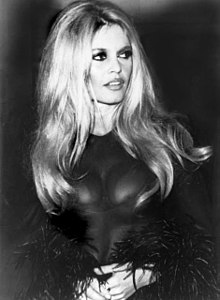
Women were inspired past the summit models of the mean solar day which included Twiggy, Jean Shrimpton, Colleen Corby, Penelope Tree, and Veruschka. Velvet mini dresses with lace-collars and matching cuffs, wide tent dresses and culottes pushed aside the geometric shift. False eyelashes were in vogue, as was pale lipstick. Hemlines kept ascension, and by 1968 they had reached well above mid-thigh. These were known as "micro-minis". This was when the "affections dress" first made its appearance on the style scene. A micro-mini dress with a flared skirt and long, wide trumpet sleeves, it was ordinarily worn with patterned tights, and was often fabricated of crocheted lace, velvet, chiffon or sometimes cotton fiber with a psychedelic impress. The cowled-cervix "monk dress" was some other organized religion-inspired alternative; the cowl could exist pulled up to be worn over the head. For evening wear, skimpy chiffon baby-doll dresses with spaghetti-straps were popular, as well as the "cocktail dress", which was a close-plumbing fixtures sheath, usually covered in lace with matching long sleeves.[32] Feather boas were occasionally worn. Famous celebrities associated with marketing the miniskirt included: Twiggy; model Jean Shrimpton, who attended an event in the Melbourne Loving cup Carnival in Australia wearing a miniskirt in 1965; Goldie Hawn, who appeared on Rowan and Martin's Laugh-In with her mini brim in 1967; and Jackie Kennedy, who wore a brusque white pleated Valentino dress when she married Aristotle Onassis in 1968.
The Single Girl [edit]

Writer, Helen Gurley Brown, wrote Sex and the Single Girl in 1962. This book acted as a guide for women of whatever marital status to have control of their ain lives financially as well as emotionally.[33] This volume was revolutionary since it encouraged sexual activity before marriage; something that was historically looked down upon. With the high success of this book, a pathway was ready for media to also encourage this behavior. Betty Friedan likewise wrote The Feminine Mystique the following yr, giving insight into the suburban female feel, further igniting women'southward push for a more contained lifestyle.[34] The 2d-wave of feminism was getting its start during this menstruation: pushing for a new feminine ideal to be capitalized on.
Fashion photography in the 1960s represented a new feminine ideal for women and immature girls: the Single Girl. 1960s photography was in sharp contrast to the models of the 1920s, who were advisedly posed for the photographic camera and portrayed every bit immobile. The Single Girl represented 'movement'. She was young, single, active, and economically self-sufficient. To represent this new Single Girl feminine ideal, many 1960s photographers photographed models exterior—often having them walk or run in fashion shoots. Models in the 1960s also promoted sports wear, which reflected the modernistic fascination with speed and the quickening pace of the 1960s urban life. Although the Single Daughter was economically, socially and emotionally self-sufficient, the platonic torso course was hard for many to achieve. Therefore, women were constrained past nutrition restrictions that seemed to contradict the image of the empowered 1960s Single Daughter.[35]
Fashion photographers likewise photographed the Single Girl wearing business vesture, calling her the Working Daughter. The Working Girl motif represented another shift for the modern, fashionable woman. Unlike earlier periods, characterized by formal evening gowns and the European expect, the 1960s Working Girl popularized mean solar day wear and "working vesture". New fix to wear lines replaced individualized formal couture fashion. The Working Daughter created an image of a new, independent woman who has command over her trunk.[35]
In that location was a new emphasis on fix-to-wear and personal style. As the 1960s was an era of exponential innovation, in that location was appreciation for something new rather than that of quality.[ten] Spending a lot of money on an expensive, designer wardrobe was no longer the ideal and women from diverse statuses would exist constitute shopping in the aforementioned stores.
The Unmarried Girl was the truthful depiction of the societal and commercial obsession with the adolescent expect.[10] Particular to the mid-sixties, icons such every bit Twiggy popularized the shapeless shift dresses emphasizing an image of innocence as they did not fit to any contours of the homo body. The female person body has forever been a sign of culturally constructed ethics.[36] The long-limbed and pre-pubescent fashion of the time depicts how women were able to be more independent, all the same paradoxically, as well were put into a box of conceived ideals.
Dolly Girl [edit]
The "Dolly Girl" was another classic for young females in the 1960s. She emerged in the mid 1960s, and her defining characteristic is the iconic mini-skirt. "Dolly Girls" also sported long hair, slightly teased, of grade, and kittenish-looking clothing. Clothes were worn tight fitting, sometimes even purchased from a children'south section. Dresses were often embellished with lace, ribbons, and other frills; the look was topped off with light colored tights. Crocheted clothing also took off within this specific manner.[37]
Corsets, seamed tights, and skirts covering the knees were no longer fashionable. The thought of buying urbanized clothing that could be worn with dissever pieces was intriguing to women of this era. In the past, one would simply buy specific outfits for certain occasions.[38]
Late 1960s (1967–1969) [edit]
The hippie subculture [edit]
Starting in 1967, youth culture began to change musically and Mod civilisation shifted to a more laid back hippie or Maverick style. Hosiery manufacturers of the time similar Mary Quant (who founded Pamela Mann Legwear) combined the "Blossom Power" way of dress and the Pop Fine art school of blueprint to create fashion tights that would appeal to a female audience that enjoyed psychedelia.[39] Ponchos, moccasins, love chaplet, peace signs, medallion necklaces, chain belts, polka dot-printed fabrics, and long, puffed "bubble" sleeves were popular fashions in the late 1960s. Both men and women wore frayed bell-bottomed jeans, tie-dyed shirts, work shirts, Jesus sandals, and headbands. Women would frequently go barefoot and some went braless. The thought of multiculturalism too became very popular; a lot of mode inspiration was drawn from traditional clothing in Nepal, Bharat, Bali, Morocco and African countries. Because inspiration was existence drawn from all over the world, there was increasing separation of style; habiliment pieces often had like elements and created like silhouettes, simply there was no real "uniform".[xl]
Fringed cadet-peel vests, flowing caftans, the "lounging" or "hostess" pajamas were also popular. "Hostess" pajamas consisted of a tunic tiptop over floor-length culottes, usually made of polyester or chiffon. Long maxi coats, often belted and lined in sheepskin, appeared at the close of the decade. Animal prints were pop for women in the autumn and winter of 1969. Women's shirts ofttimes had transparent sleeves. Psychedelic prints, hemp and the look of "Woodstock" emerged during this era.[ citation needed ]
Indian style [edit]

Middle class Indian menswear followed postwar European trends, but about women continued to article of clothing traditional clothes such as the sari.
In general, urban Indian men imitated Western fashions such as the business organisation accommodate. This was adapted to India's hot tropical climate as the Nehru adjust, a garment oft made from khadi that typically had a mandarin collar and patch pockets. From the early 1950s until the mid 1960s, most Indian women maintained traditional dress such as the gagra choli, sari, and churidar. At the same time as the hippies of the belatedly 1960s were imitating Indian fashions, however, some fashion conscious Indian and Ceylonese women began to incorporate modernist Western trends.[41] I particularly infamous fad combined the miniskirt with the traditional sari, prompting a moral panic where conservatives denounced the so-called "hipster sari"[42] as indecent.
Feminist influences [edit]
During the belatedly 1960s, at that place was a backfire past radical feminists in America against accouterments of what they perceived to exist enforced femininity within the fashion manufacture. Instead, these activists wore androgynous and masculine vesture such equally jeans, work boots or berets. Blackness feminists oft wore afros in reaction to the hair straighteners associated with middle class white women. At the 1968 feminist Miss America protest, protestors symbolically threw a number of feminine fashion-related products into a "Freedom Trash Can," including false eyelashes, high-heeled shoes, curlers, hairspray, makeup, girdles, corsets, and bras[43] which they termed "instruments of female torture".[44]
Men'south fashion [edit]
Early 1960s (1960–1962) [edit]
Business organization wear [edit]

During the early on 1960s, slim plumbing fixtures unmarried breasted continental manner suits and skinny ties were stylish in the United kingdom and America. These suits, as worn past Sean Connery as James Bond, the Rat Pack'due south Frank Sinatra,[45] and the bandage of Mad Men, were often made from grey flannel, mohair or sharkskin.[46] Tuxedos were cut in a like class fitting style, with shawl collars and a single push button, and were available either in the traditional blackness, or in bright colors such as ruddy or heaven blue popularized past Frankie Valli of The Four Seasons. Men's hats, including the pork pie hat and Irish hat, had narrower brims than the homburgs and fedoras worn in the 1950s and before. During the mid 1960s, hats began to decline[47] after presidents John F. Kennedy and Lyndon B. Johnson appeared in public without i.[48]
Ivy League [edit]

Ivy League style, the precursor to the modernistic preppy look, was desirable coincidental wear for middle class adults in America during the early to mid 1960s. Typical outfits included polo shirts, harrington jackets, khaki chino pants, striped T-shirts, Argyle socks, seersucker or houndstooth sportcoats, sweater vests, cardigan sweaters, Nantucket Reds, basketweave loafers, Madras plaid shirts, and narrow brimmed Trilbys sometimes made from straw.[49] [fifty] The manner remained stylish for men over 21 until it was supplanted by more casual everyday clothing influenced by the hippie counterculture during the belatedly 1960s and early on 1970s.[51]
Mid 1960s (1963–1966) [edit]
Surf fashion [edit]

In America and Australia, surf rock went mainstream from 1962 to 1966, resulting in many teenage baby boomers imitating the outfits of groups like The Beach Boys. Pendleton jackets were common due to their cheapness, warmth and durability. Design wise the surf jacket suited popularly with nonchalance, warmth for coastal Californian climate, and utility pockets for surf wax and VW car keys, 2 surf essentials (Pendleton Woolen Mills).[52]
The Pendleton Surf Jacket expanded upon Fifties pop-cultural fashions, however new in its relaxed, intangibly cool vibe. The surf jacket split from the tough guy stone 'due north' curlicue teen, and mellowing leather'southward rock attitudes to woolen plaids. Following Rock due north Roll'southward pass up were rebels without causes, "Greasers" and "Beats"; dressed down in inappropriate daywear to denounce conformity, Sixties youth, inventors of Surf Fashion, expressed more nomadic and hedonically in this "dress down" fashion. Surf styles mainstreamed into fashion when Soul Surfers wanted to brand livings in surfing-associated careers. They opened businesses that expanded selling surf products into selling surf wearable. These surfer entrepreneurs proliferate surf fashion by mixing their lifestyles into casual wear.[53] Equally Rock n Roll Beats, and Greaser machine clubs used jackets to identify, and every bit 1950 varsity sports wore lettered cardigans, 1960s Surfies wore surf jackets to place with surf clubs and as surfers (Retro 1960s Swimwear).[54] Jackets worn as group status identifiers continued in the Sixties, but with focus around beach music and lifestyle.
Equally surfers banded over localism, plaid and striped surf jackets gained relevancy. Teens wore them to proclaim surf clubs; what embankment they were from, and where they surfed. For a surfer though, information technology is curious why a woolen plaid jacket paired with UGG boots, and not the board-short or aloha shirt identified the surfer. The Pendleton plaid, originally worn past loggers, hunters and fishermen, was a mutual item of casual wear for American men of all classes before the British invasion. For the youth of the 60s, all the same, the plaid Pendleton signified counterculture, and tribal seamen style translated from Welsh folklore, rebellious Scots Highlanders, and rugged American frontiersmen (Bowe).[55]
The Sixties invented the Californian Cool style, by relaxing style to escape Cold State of war meltdowns with Polynesian fascinations, bridging the manlike 1950s teen towards 1960s Hippie fashion. The Cold State of war'south tense political context conceived Surf Manner as a mode to relax and escape established violence. California, the birthplace of American Surfing, also produced much of the applied science experimentations used in the nuclear space race. Caltech designers in Pasadena were designing nuclear arms for day jobs and were surfing at nighttime. The modern surfboard design itself originates from the military machine-industrial complex'south production development, where the Manhattan Projection's Hugh Bradner also designed the modern neoprene wetsuit (Within the Scroll).[56]
Californian engineers for the Cold State of war were likewise surfing and as engineering that fashion. Just as the Bikini's proper noun comes from a nuclear exam site, Surf fashion in this era consistently references the Common cold War context. Surfing became an attractive fashion identity in this era because it perpetuates adolescence, and the pursuit of pleasure in times of anxiety and paranoia. In a teenage-driven culture, which aimed to ignore establishment conflicts, surfers mused Hawaii and its associated tiki civilisation as a place of escape with tropical paradises as the antithesis to mod society. This sustained Hawaiian flora and fauna patterns' in fashion its attraction. The Sixties Surfer was not the first to escape violence or revolutionize the pursuit of happiness through Polynesian fascination. Accounts of Thomas Jefferson theorize that his exposure to the surfer paradigm in South Pacific travel journals influenced his imagined Pursuit of Happiness (Martin D. Henry).[57] Similarly, Hawaii'due south surfer image and Californian translation responds to the decade's violence and further inspired full-on irenic revolutionary Hippie fashions.
Additionally, as Californian water inspired lifestyles influenced fashion, many guys improvised their own faded jeans using chlorine from backyard swimming pools.[58] Sneakers such equally Converse All Stars fabricated the transition from sportswear to streetwear, and guys in California and Hawaii began to abound out their hair.[59]
Modern and British Invasion influences [edit]

The Mods were a British way miracle in the mid-1960s with their parkas, tailored Italian suits, and scooters.
The leaders of mid-1960s style were the British. The Mods (curt for Modernists) adopted new fads that would be imitated past many young people. Mods formed their ain way of life creating television shows and magazines that focused directly on the lifestyles of Mods.[1] British stone bands such equally The Who, The Modest Faces, the Beatles, and The Kinks emerged from the Mod subculture. Information technology was not until 1964, when the Modernists were truly recognized past the public, that women actually were accepted in the group. Women had brusk, clean haircuts and ofttimes dressed in similar styles to the male Mods.[four]
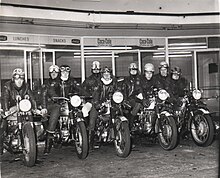
The Mods' lifestyle and musical tastes were the exact opposite of their rival group, known equally the Rockers. The rockers liked 1950s rock-and roll, wore black leather jackets, greased, pompadour hairstyles, and rode motorbikes. The await of the Mods was swish. They mimicked the clothing and hairstyles of loftier fashion designers in France and Italia, opting for tailored suits that were topped by anoraks. They rode on scooters, commonly Vespas or Lambrettas. Mod fashion was oft described as the City Gent look. The young men[60] incorporated striped boating blazers and bold prints into their wardrobe.[61] Shirts were slim, with a necessary push button down collar accompanied by slim fitted pants.[4] Levi'south were the only type of jeans worn by Modernists.
In the USSR during the mid to late 1960s, Mods and Hippies were nicknamed Hairies for their mop acme hair.[62] Every bit with the earlier Stilyagi in the 1950s, young Russian men who dressed this manner were ridiculed in the media, and sometimes forced to get their hair cutting in police stations.[63]
Late 1960s (1967–1969) [edit]
Folk and counterculture influences [edit]

The late 1960s to early 1970s witnessed the emergence of the hippie counterculture and freak scene in U.k., Australia, New Zealand and America. Centre class youths of both sexes favored a unisex await with long hair, necktie dye and flower ability motifs, Bob Dylan caps, kurtas, hemp waistcoats, baja jackets, bell bottoms, sheepskin vests, western shirts and ponchos inspired past acid Westerns, sandals, digger hats, and patches featuring flowers or peace symbols.[64] Jimi Hendrix popularized the wearing of sometime military wearing apparel uniforms as a statement that war was obsolete.[65] Early hippies, derisively referred to equally freaks by the older generation, also used elements of roleplay such as headbands, cloaks, frock coats, kaftans, corduroy pants, cowboy boots, and vintage clothing from charity shops, suggesting a romantic historical era, a distant region, or a gathering of characters from a fantasy or science fiction novel.[66]
Peacock Revolution [edit]

Past 1968, the space age mod fashions had been gradually replaced by Victorian, Edwardian and Belle Époque influenced way, with men wearing double-breasted suits of crushed velvet or striped patterns, brocade waistcoats and shirts with frilled collars. Their hair worn below the collar bone. Rolling Stones guitarist Brian Jones epitomised this "dandified" look. Due to the colorful nature of menswear, the time menstruum was described as the Peacock Revolution, and male trendsetters in United kingdom and America were called "Dandies," "Dudes," or "Peacocks."[67] From the late 60s until the mid 70s Carnaby Street and Chelsea's Kings Road were virtual fashion parades, every bit mainstream menswear took on psychedelic influences. Business suits were replaced by Maverick Carnaby Street creations that included corduroy, velvet or brocade double breasted suits, frilly shirts, cravats, wide ties and trouser straps, leather boots, and even collarless Nehru jackets. The slim neckties of the early 60s were replaced with Kipper ties exceeding five inches in width, and featuring crazy prints, stripes and patterns.[68]
Hairstyles of the 1960s [edit]
Women'south hairstyles [edit]

Women's hair styles ranged from beehive hairdos in the early part of the decade to the very short styles popularized by Twiggy and Mia Farrow simply v years subsequently to a very long direct way as popularized by the hippies in the late 1960s. Between these extremes, the chin-length contour cut and the pageboy were besides popular. The pillbox hat was fashionable, due nearly entirely to the influence of Jacqueline Kennedy, who was a manner-setter throughout the decade. Her bouffant hairstyle, described as a "grown-up exaggeration of little girls' hair", was created by Kenneth.[69] [70]
During the mid and late 1960s, women's hair styles became very big and used a large quantity of hair spray, every bit worn in real life by Ronnie Spector and parodied in the musical Hairspray. Wigs became fashionable and were often worn to add together style and pinnacle. The almost important change in hairstyles at this time was that men and women wore androgynous styles that resembled each other. In the UK, it was the new fashion for modernistic women to cut their hair short and shut to their heads.[71] Meanwhile, hippie girls favored long, straight natural hair, kept in place with a bandana.
Men's hairstyles [edit]

For professional men born before 1940, the side parted short back and sides was the norm in the Great britain, Europe and America from the early on 60s until the end of the decade. Black men usually buzzed their hair short or wore styles like the conk, artificially straightened with chemicals. Bluish collar white men, especially former war machine personnel, often wore buzzcuts and flat tops during the summer. During the early on to mid 60s, rebellious Irish gaelic-American, Italian-American and Hispanic teens influenced past the greaser subculture often wore ducktails, pompadours and quiffs.[ citation needed ]
Due to the influence of modernistic bands like the Beatles or the Rolling Stones, mop-elevation hairstyles were about popular for white and Hispanic men during the mid 60s.[ commendation needed ] The mod haircut began every bit a short version around 1963 through 1964, developed into a longer style worn during 1965–66, and somewhen evolved into an unkempt hippie version worn during the 1967–1969 period and into the early on 1970s. Facial pilus, evolving in its extremity from simply having longer sideburns, to mustaches and goatees, to full-grown beards became popular with young men from 1966 onwards.
Caput coverings changed dramatically towards the cease of the decade every bit men's hats went out of style, replaced past the bandanna, digger chapeau, Stetson, or Bob Dylan cap if anything at all. As men let their hair grow long, the Afro became the hairstyle of choice for African Americans.[ citation needed ] This afro was not just a fashion statement but also an emblem of racial pride. They started to believe that by allowing their hair to grow in its nature land without chemical treatments, they would be accepting their racial identities.[72]
Image gallery [edit]
A selection of images representing the fashion trends of the 1960s:
-

Showtime Lady Jacqueline Kennedy wearing a scarlet wool dress with matching jacket. She was a mode icon in the early on 1960s.
-

Vocalizer and actress Barbra Streisand in 1962 wearing a acme with a coiffure-neck. Her hair is teased at the crown.
-

-
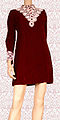
A velvet minidress from 1965.
-

American girl wearing a mini skirt and patterned tights, 1966.
-

Fashion model from Leipzig, Gdr wearing a wool suit trimmed with fur and a matching fur hat, 1966.
-

Young adult female wears her hair in a headband with flipped ends, 1967.
-
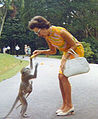
Woman at a Singapore zoo, 1967. Annotation her Pucci-style print dress.
-
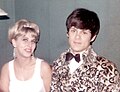
The pop "dandified" male way in 1968.
-

In the belatedly 1960s, brides oft wore white mini nuptials dresses.
Run into also [edit]
Fashion designers [edit]
- Barbara Hulanicki
- Rudi Gernreich
- Bill Gibb
- Guy Laroche
- Emilio Pucci
- Jean Muir
- Mary Quant
- Paco Rabanne
- Oscar de la Renta
- Yves Saint-Laurent (designer)
- Mila Schön
Style icons [edit]
- Marella Agnelli
- Anouk Aimée
- Brigitte Bardot
- Jane Birkin
- Amanda Burden
- Pattie Boyd
- Claudia Cardinale
- Cher
- Consuelo Crespi
- Julie Christie
- Catherine Deneuve
- Farah Diba
- Faye Dunaway
- Jane Fonda
- Dolores Guinness
- Gloria Guinness
- Audrey Hepburn
- Jacqueline Kennedy
- Sophia Loren
- Infant Paley
- Lee Radziwill
- Vanessa Redgrave
- Jacqueline de Ribes
- Diana Ross
- Diana Rigg
- Edie Sedgwick
- Nancy Sinatra
- Queen Sirikit
- Sharon Tate
- Raquel Welch
- Steve Winwood
- Natalie Forest
- Stevie Wright
- Jayne Wrightsman
- Harry Vanda
- Gloria Vanderbilt
Supermodels [edit]
- Marisa Berenson
- Pattie Boyd
- Capucine
- Colleen Corby
- Cathee Dahmen
- Celia Hammond
- Lauren Hutton
- Donyale Luna
- Nico
- Jean Shrimpton
- Penelope Tree
- Twiggy
- Veruschka
- Agneta Frieberg
Fashion photographers [edit]
- Richard Avedon
- David Bailey
- Cecil Beaton
- Hiro (lensman)
- William Klein
- Patrick Lichfield
- Terry O'Neill
- Norman Parkinson
- Lord Snowdon
- Bert Stern
Teenage subcultures [edit]
- Greaser subculture
- Rocker subculture
- Raggare
- Bodgies
- Modern subculture
- Soc subculture
- Youthquake
- Surfer
- Beatnik
- Hippie
- Rude Boy
- Skinhead
- Blackness Panthers
Other [edit]
- Carnaby Street
- Miniskirt
- Swinging London
- Twiggy
- Vogue
- Diana Vreeland
References [edit]
- ^ a b "Braggs, Steve, and Diane Harris. 60s Mods". Retrowow.co.uk. March 1, 2009.
- ^ Rich Candace (2010–2015). "Makeup". Fiftiesweb.com.
- ^ Dir. Vidcat1. Redtube (February thirteen, 2007). "Vintage Style Newsreels 1960s". Youtube.com. Archived from the original on 2010-05-07. Retrieved March 27, 2009.
- ^ a b c d "Braggs, Steve, and Diane Harris. 60s Mods". Retrowow.co.uk. March ane, 2009.
- ^ "Goodwin, Susan, and Becky Bradley. American Cultural History: 1960–1969". Kingwood College Library. Kclibrary.lonestar.edu. March 1, 2009. Archived from the original on March 1, 2009.
- ^ "Audrey Hepburn's way hits". Harper's BAZAAR. 2014-05-02. Retrieved 2016-02-08 .
- ^ 1962 Sears catalog
- ^ Deslandres, François Boucher; with a new chapter by Yvonne (1987). 20,000 Years of Mode : the history of costume and personal beautification (Expanded ed.). New York: Harry Due north. Abrams. ISBN0-8109-1693-2.
- ^ a b Pavitt, Jane (2008). Fear and fashion in the Cold War. London: V&A Pub. p. sixty. ISBN9781851775446.
- ^ a b c Walford, Johnathan (2013). Sixties way: From less is more to youthquake. London: Thames & Hudson. p. 110. ISBN9780500516935.
- ^ Pierre Cardin
- ^ Yotka, Steff. "Remembering André Courrèges". Vogue . Retrieved 2016-05-19 .
- ^ BBC Civilisation: Space age fashion
- ^ "Fashion for the '70s: Rudi Gernreich Makes Some Modest Proposals". Life. Vol. 68, no. 1. 1970-01-09. pp. 115–118. Retrieved 2022-01-03 .
- ^ "Jean-Marie Armand". Couture Allure. 2011-03-08. Retrieved 2021-12-thirteen .
His designs were very modern and architectural, much like those of Courreges and Cardin.
- ^ Howell, Georgina (1978). "1963". In Vogue: Sixty Years of Celebrities and Fashion from British Vogue. Harmondsworth, Middlesex, England: Penguin Books Ltd. pp. 280, 283. ISBN0-14-00-4955-X.
Saint Laurent'due south black and white geometric shifts...Saint Laurent: Black ciré smock[, helmet,] and thigh-high alligator boots.
- ^ Peake, Andy (2018). "Chapeau Melon et Bottes de Cuir". Made for Walking. Atglen, Pennsylvania: Schiffer Mode Printing. p. 57. ISBN978-0-7643-5499-one.
Yves Saint Laurent's autumn...1963...visored caps, black leather jerkins, and Roger Vivier's...thigh-high...boots in crocodile gave what [the Daily Mail 'due south Iris] Ashley called 'a real space girl effect...'
- ^ "1965 Homage to Piet Mondrian". Musée Yves Saint Laurent Paris . Retrieved 2022-01-09 .
- ^ Howell, Georgina (1978). "1966". In Faddy: 60 Years of Celebrities and Fashion from British Vogue. Harmondsworth, Middlesex, England: Penguin Books Ltd. p. 292. ISBN0-14-00-4955-X.
Saint Laurent makes his shifts...transparent except where they are striped or chevroned with silver sequins.
- ^ Howell, Georgina (1978). "1966". In Vogue: Threescore Years of Celebrities and Fashion from British Vogue. Harmondsworth, Middlesex, England: Penguin Books Ltd. p. 292. ISBN0-fourteen-00-4955-X.
Space projections...plastic, chrome, Dynel...everything argent, from visor to stockings and shoes...[Y]ou wearable silver leather and plastic concatenation mail, skirts that show the whole length of your legs, mops of bogus hair coloured pink, green and purple, chrome jewellery, and visor sunglasses....huge plastic disc earrings, silver stockings, silver shoes laced up the leg, bangles of clear plastic and chrome. Argent leather or shirred silver nylon make the new jackets...and eye make-up is designed to be seen from 100 yards, in streamlined eyeliners, black and white used alternately...
- ^ Howell, Georgina (1978). "1967-68". In Vogue: Sixty Years of Celebrities and Manner from British Vogue. Harmondsworth, Middlesex, England: Penguin Books Ltd. p. 296. ISBN0-14-00-4955-X.
1967-68...mark[ed] the change in direction from futurist to romantic style....[i]northward reaction to the uniformity of geometric haircuts and 'functional' fashion, stiff carved tweed shifts and creaking plastic...
- ^ a b "Pierre Cardin". Encyclopædia Britannica. Encyclopædia Britannica. 2016. Retrieved 2016-05-18 .
- ^ Kennedy, Alicia (2013). Manner design, referenced: A visual guide to the history, linguistic communication, and practice of mode. Gloucester. MA: Rockport. ISBN978-1592536771.
- ^ Parks, C. (2015, March 23). The Miniskirt: An Development From The '60s To Now. Retrieved October xxx, 2016, from http://www.huffingtonpost.com/2015/03/23/mini-skirt-evolution_n_6894040.html
- ^ Paula Reed. (2012). In 50 Manner Looks that Changed the 1960s (pp. xxx–31). England: Alison Starling.
- ^ Koda, H. (2010). 100 Dresses: The Costume Institute, The Metropolitan Museum of Fine art. S.50.: Yale University Press.
- ^ Blackman, C. (2012). 100 Years of Fashion. London: Laurence King Pub.
- ^ Nectara, J (2012, July 13). "The Miniskirt – A Curt History." Retrieved October 30, 2016, from [1]
- ^ Bourne, 50. (2014). "A history of the Miniskirt: How fashion's nigh daring hemline came to be." Retrieved Oct 30, 2016, from http://stylecaster.com/history-of-the-mini-skirt/
- ^ Niara. (2016, January nine). "Aesthetics and Activism: The history of miniskirt." Retrieved October 30, 2016, from http://www.collegefashion.net/inspiration/the-history-of-the-miniskirt/
- ^ Tarrant, Naomi (1994). The Development of Costume. London: Routledge. p. 88.
- ^ Contini, p. 317
- ^ Brown, Helen Gurley (1962). Sex and the Unmarried Girl. Bernard Geis Associates. ISBN9781569802526.
- ^ Friedan, Betty (1963). The Feminine Mystique. W. W. Norton and Co. ISBN0-393-32257-ii.
- ^ a b Radner, Hilary (2001). "Embodying the Unmarried Girl in the 1960s". In Joanne Entwistle and Elizabeth B. Wilson (ed.). Body Dressing. Bloomsbury Bookish. pp. 183–197. ISBN1859734448.
- ^ Evans, C. (1991). "Way, Representation, Femininity". Feminist Review. 38: 48–66. doi:10.1057/fr.1991.19. S2CID 143932525.
- ^ Bail, David (1981). The Guinness Guide to 20th Century Fashion. Middlesex: Guinness Superlatives Limited. pp. 164, 176. ISBN 0851122345
- ^ Belinda T. Orzada (2000-01-10). "Orzada, Belinda T. "Fashion Trends and Cultural Influences 1960-nowadays." Twentieth Century Design: Ethnic Influences. vii Oct. 1998. Academy of Delaware. ten Apr. 2009". Udel.edu. Archived from the original on 2012-06-18. Retrieved 2012-08-11 .
- ^ Hosiery Trends Over The Decades
- ^ Miles, Barry (2004). Hippie. Sterling. ISBN1402714424.
- ^ "Reading Hawkeye - Google News Archive Search". news.google.com.
- ^ "Gadsden Times - Google News Archive Search". news.google.com.
- ^ Dow, Bonnie J. (Spring 2003). "Feminism, Miss America, and Media Mythology". Rhetoric & Public Affairs. 6 (1): 127–149. doi:ten.1353/rap.2003.0028. S2CID 143094250.
- ^ Duffett, Judith (October 1968). WLM vs. Miss America. Voice of the Women's Liberation Move. p. 4.
- ^ "A guide to Suit Issues for men". 11 Dec 2012. Archived from the original on February fourteen, 2013.
- ^ "Mohair Suiting Fabric Guide — Gentleman'south Gazette". www.gentlemansgazette.com.
- ^ "The History And Corruption of The Fedora".
- ^ "Top Hats and Bibles: Inauguration Traditions". ABC News. 19 January 2009.
- ^ "League of gentlemen: How to get the effortlessly cool way of Paul". 2010-09-nineteen.
- ^ "Claudio De Rossi talks Ivy with Jimmy Frost Mellor - Modculture". 26 October 2017.
- ^ "The Ivy Way Primer — Admirer'southward Gazette". www.gentlemansgazette.com.
- ^ "Pendleton Woolen Mills - An Unlikely Surf Icon". Heddels. 2016-09-12. Retrieved 2018-04-15 .
- ^ Jones, Glynis (2010). Subcultural and Culling Clothes in Commonwealth of australia. Vol. 7. doi:ten.2752/bewdf/edch7034. ISBN9781847888563.
- ^ "Retro 1960s Swimwear, Beachwear and Surf Fashion". Dust Manufacturing plant Vintage Clothing Wholesale. 2016-06-26. Retrieved 2018-04-fifteen .
- ^ "The History of Flannel - Gear Patrol". Gear Patrol. 2014-10-02. Retrieved 2018-04-15 .
- ^ "Inside the Curl: Surfing's Surprising History". 2013-08-04. Retrieved 2018-04-15 .
- ^ Martin D. Henry (ITQ, vol. 63/3, 1998, 250–62)
- ^ Stebbins, Jon (1 September 2011). The Beach Boys FAQ: All That's Left to Know About America'southward Ring. Backbeat Books. ISBN9781458429148 – via Google Books.
- ^ Inc, Nielsen Business Media (29 June 1963). "Billboard". Nielsen Business Media, Inc. – via Google Books.
- ^ Pendergast, Tom and Sarah (2004). Fashion, Costume and Civilization. MI, Us: Thomson Gale. p. 895. ISBN0-7876-5422-i.
- ^ "For Your Love: The Best of the Sixties British Invasion". Rolling Stone. 2014-06-02. Retrieved 2016-02-08 .
- ^ Jackson, Andrew Grant (iii Feb 2015). 1965: The Well-nigh Revolutionary Year in Music. Macmillan. ISBN9781466864979 – via Google Books.
- ^ Safanov, Mikhail (8 August 2003). "Confessions of a Soviet moptop". The Guardian.
- ^ "Photos of hippies". Archived from the original on 2016-07-03. Retrieved 2017-11-27 .
- ^ "Troubled Times: 1961–79 – Way, Costume, and Culture: Clothing, Headwear, Body Decorations, and Footwear through the Ages". www.fashionencyclopedia.com . Retrieved 2017-10-07 .
- ^ "Bell-Bottoms facts, information, pictures | Encyclopedia.com articles about Bong-Bottoms". world wide web.encyclopedia.com . Retrieved 2017-x-07 .
- ^ "The Peacock Revolution". The Peacock Revolution and the Beatles: British Men'due south Fashion from 1963–1973 . Retrieved 2017-ten-07 .
- ^ Marshall, Peter (Feb 27, 2009). "Peacock Revolution: Informal Counterculture". Black-tie-guide 2009. Archived from the original on 2016-10-xix.
- ^ Collins, Amy Fine (one June 2003). "Information technology had to be Kenneth.(hairstylist Kenneth Battelle)(Interview)". Vanity Fair . Retrieved iii Dec 2012.
- ^ Wong, Aliza Z. (2010). Julie Willett (ed.). The American beauty industry encyclopedia: Hairstylists, Celebrity. Santa Barbara, Calif.: Greenwood. pp. 151–154. ISBN9780313359491.
- ^ Pendergast, Tom and Sarah (2004). Fashion, Costume and Culture. MI, The states: Thomson Gale. p. 935. ISBN0-7876-5422-one.
- ^ Pendergast, Tom and Sarah (2004). Way, Costume and Culture. MI, USA: Thomson Gale. pp. 937–938. ISBN0-7876-5422-i.
External links [edit]
- "1960s Fashion and Textiles collection". Fashion, Jewellery & Accessories. Victoria and Albert Museum. Retrieved 2007-06-08 .
- "60s Mode in the Round". Manner, Jewellery & Accessories. Victoria and Albert Museum. Archived from the original on 2007-11-26. Retrieved 2007-12-09 .
- "1960s - 20th Century Fashion Drawing and Illustration". Fashion, Jewellery & Accessories. Victoria and Albert Museum. Archived from the original on 2011-07-14. Retrieved 2011-04-03 .
- "Swing Fashion – Coats and Jackets". Swing Way. Manner Ode. Archived from the original on 2015-01-12. Retrieved 2014-12-23 .
- Everyday Life in the 1960'south - Expired Noesis
0 Response to "1960 Mens Fashion How Many Hairstyles Were Famous in the 1960s"
Post a Comment