Tacky Old Jewish Men Clothes Fashion
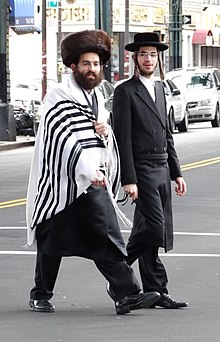
Jewish religious habiliment is apparel worn by Jews in connexion with the practice of the Jewish faith. Jewish religious wearable has changed over time while maintaining the influences of biblical commandments and Jewish religious law regarding clothing and modesty (tzniut). Contemporary styles in the wider civilization also take a bearing on Jewish religious clothing, although this extent is limited.
Historical background [edit]
The Torah set forth rules for clothes that, following later rabbinical tradition, were interpreted as setting Jews apart from the communities in which they lived.[1]
Classical Greek and Roman sources, that often ridicule many aspects of Jewish life, exercise non remark on their vesture and subject it to caricature, every bit they do when touching on Celtic, Germanic, and Persian peoples, and mock their different modes of apparel.[2] Cultural anthropologist Eric Silverman argues that Jews in the late antiquity period used clothes and hair-styles like the people effectually them.[3] At 2 Maccabees 4:12, information technology is said that the Maccabees slaughtered Jewish youths guilty of Hellenizing in wearing caps typical of Greek youths.[three]
In many Islamic countries, Jewish men typically wore tunics, instead of trousers. In the aforementioned countries, many different local regulations emerged to make Christian and Jewish dhimmis expect distinctive in their public advent. In 1198, the Almohad emir Abu Yusuf Yaqub al-Mansur decreed that Jews must wear a dark blue garb, with very large sleeves and a grotesquely oversized hat;[4] his son altered the color to yellowish, a change that may have influenced Cosmic ordinances some time later.[iv] German ethnographer Erich Brauer (1895–1942) noted that in Yemen of his fourth dimension, Jews were not allowed to wear habiliment of whatever color besides blue.[5] Earlier, in Jacob Saphir's time (1859), they would wear outer garments that were "utterly black".[ commendation needed ]
Men's clothing [edit]
Many Jewish men historically wore turbans or habits,[6] tunics,[7] cloaks, and sandals in summertime.[8] Oriental Jewish men in late-Ottoman and British Mandate Palestine would habiliment the tarbush on their heads.[nine]

A Yemenite Jewish elder wearing a sudra with central hat
Tallit, tzitzit [edit]
The tallit is a Jewish prayer shawl worn while reciting morning prayers likewise as in the synagogue on Shabbat and holidays. In Republic of yemen, the wearing of such garments was not unique to prayer fourth dimension lone just was worn the entire twenty-four hour period.[10] In many Ashkenazi communities, a tallit is worn only after wedlock. The tallit has special twined and knotted fringes known as tzitzit attached to its four corners. It is sometimes referred to as Arba kanfot (lit. 'iv corners')[xi] although the term is more common for a tallit katan, an undergarment with tzitzit. According to the Biblical commandments, tzitzit must be attached to any four-cornered garment, and a thread with a blue dye known equally tekhelet was originally included in the tzitzit, although the missing blue thread does not impair the validness of the white.[12] Jewish tradition varies with respect to burying with or without a tallit. While all the deceased are buried in tachrichim (burial shrouds), some communities (Yemenite Jews) exercise not coffin their expressionless in their tallit. The Shulhan Arukh and the Tur, yet, post-obit the legal opinion of the Ramban, require burying the expressionless with their tallit,[13] and which has become the general exercise amongst nigh religious Jews. Among others, the matter is dependent upon custom.

Since tzitzit are considered to be a time-leap commandment, merely men are required to wear them.[14] Authorities have differed as to whether women are prohibited, permitted or encouraged to wear them. Medieval authorities tended toward leniency, with more prohibitive rulings gaining in precedence since the 16th century.[fifteen] Conservative Judaism regards women as exempt from wearing tzitzit, not as prohibited,[xvi] and the tallit has become more mutual among Conservative women since the 1970s.[17] [18] Some progressive Jewish women choose to take on the obligations of tzitzit and tefillin,[nineteen] and information technology has go common for a girl to receive a tallit when she becomes bat mitzvah.[eighteen] [xx] [21]
Kippah [edit]
A kippah or yarmulke (also called a kappel or skull cap) is a thin, slightly-rounded skullcap traditionally worn at all times by Orthodox Jewish men, and sometimes by both men and women in Bourgeois and Reform communities. Its use is associated with demonstrating respect and reverence for God.[22] Jews in Arab lands did not traditionally wear yarmulkes, but rather larger, rounded, brimless hats, such as the kufi or tarboush.[ citation needed ]
Kittel [edit]
A kittel (Yiddish: קיטל) is a white, knee-length, cotton robe worn past Jewish prayer leaders and some Orthodox Jews on the Loftier Holidays. In some families, the head of the household wears a kittel at the Passover seder,[23] while in other families all married men wear them.[23] [24] In many Ashkenazi Orthodox circles, it is customary for the groom to vesture a kittel under the chuppah (wedding ceremony canopy).[ citation needed ]
Women's habiliment [edit]

Married observant Jewish women article of clothing a scarf ( tichel or mitpahat ), snood, hat, beret, or sometimes a wig (sheitel) in order to conform with the requirement of Jewish religious law that married women cover their hair.[25] [26]
Jewish women were distinguished from others in the western regions of the Roman Empire by their custom of veiling in public. The custom of veiling was shared by Jews with others in the eastern regions.[27] The custom petered out amidst Roman women, but was retained by Jewish women equally a sign of their identification as Jews. The custom has been retained among Orthodox women.[28] Evidence drawn from the Talmud shows that pious Jewish women would wear shawls over their heads when they would exit their homes, but there was no practise of fully covering the face.[29] In the medieval era, Jewish women started veiling their faces nether the influence of the Islamic societies they lived in.[30] In some Muslim regions such as in Baghdad, Jewish women veiled their faces until the 1930s. In the more lax Kurdish regions, Jewish women did not cover their faces.[31]
Jewish vs gentile community [edit]
Based on the rabbinic traditions of the Talmud, the 12th century philosopher Maimonides forbade emulating gentile dress and wearing apparel when those same items of article of clothing accept immodest designs, or that they are continued somehow to an idolatrous practise, or are worn because of some superstitious practice (i. east., "the ways of an Amorite").[32]
A question was posed to 15th-century Rabbi Joseph Colon (Maharik) regarding "gentile clothing" and whether or not a Jew who wears such clothing transgresses a biblical prohibition that states, "You shall non walk in their precepts" (Leviticus 18:3). In a protracted responsum, Rabbi Colon wrote that whatsoever Jew who might be a practising physician is permitted to wear a dr.'s cape (traditionally worn by gentile physicians on account of their expertise in that item field of scientific discipline and their wanting to be recognized as such), and that the Jewish doctor who wore information technology has non infringed upon whatever law in the Torah, even though Jews were not wont to wear such garments in former times.[33] He noted that there is naught attributed to "superstitious" practice past their wearing such a garment, while, at the same time, there isn't anything promiscuous or immodest almost wearing such a cape, neither is information technology worn out of haughtiness. Moreover, he has understood from Maimonides (Hilkhot Avodat Kokhavim 11:1) that at that place is no commandment requiring a fellow Jew to seek out and look for vesture which would brand them stand out every bit "unlike" from what is worn by gentiles, merely rather, only to make certain that what a Jew might wear is not an "exclusive" gentile item of clothing. He noted that wearing a dr.'s cape is not an exclusive gentile custom, noting, moreover, that since the custom to wear the cape varies from identify to place, and that, in France, physicians do not have it as a custom to clothing such capes, it cannot therefore exist an sectional Gentile custom.[33]
According to Rabbi Colon, modesty was notwithstanding a criterion for wearing gentile clothing, writing: "...even if Israel made it equally their custom [to wear] a certain item of clothing, while the Gentiles [would wear] something dissimilar, if the Israelite garment should not measure upward to [the standard established in] Judaism or of modesty more than than what the Gentiles hold every bit their practice, at that place is no prohibition whatsoever for an Israelite to habiliment the garment that is practised amidst the Gentiles, seeing that it is in [keeping with] the mode of fitness and modesty simply every bit that of Israel."[33]
Rabbi Joseph Karo (1488–1575), following in the footsteps of Colon, ruled in accordance with Colon's education in his seminal work Beit Yosef on the Tur (Yoreh De'ah §178), and in his commentary Kessef Mishneh (on Maimonides' Mishne Torah, Hilkhot Avodat Kokhavim 11:i), making the wearing of gentile clothing contingent upon three factors: i) that they non be promiscuous clothing; 2) non be clothing linked to an idolatrous practice; iii) not be clothing that was worn because of some superstitious practise (or "the way of the Amorites"). Rabbi Moses Isserles (1530–1572) opines that to these strictures can be added one additional prohibition of wearing wearing apparel that are a "custom" for them (the gentiles) to article of clothing, that is to say, an exclusive gentile custom where the article of clothing is immodest.[34] Rabbi and posek Moshe Feinstein (1895–1986) subscribed to the same strictures.[35]
See also [edit]
- Biblical clothing
- Jewish lid
- Kaftan
- Religious clothing
References [edit]
- ^ Silverman, Eric (2013). A Cultural History of Jewish Dress. London and New York: Bloomsbury Academic. p. 15. ISBN978-ane-84520-513-3.
Jews dressed differently every bit God's outcasts. But Jews also dressed differently in premodern Europe because their rabbis understood whatever emulation of not-Jews equally a violation of the divine Law as revealed by God to Moses atop Mount Sinai. The Five Books of Moses, afterwards all, together chosen the Torah, clearly specify that Jews must adhere to a detail dress code-modesty, for example, and fringes. The very construction of the cosmos demanded nothing less. Wearable, as well, served as a "fence" that protected Jews from the profanities and pollutions of the non-Jewish societies in which they dwelled. From this angle, Jews dressed distinctively as God'southward elect.
- ^ Silverman, Eric (2013). A Cultural History of Jewish Dress. London and New York: Bloomsbury Bookish. pp. XV, 24. ISBN978-one-84520-513-3.
- ^ a b Silverman, Eric (2013). A Cultural History of Jewish Apparel. London and New York: Bloomsbury Bookish. pp. 24–26. ISBN978-i-84520-513-3.
- ^ a b Silverman, Eric (2013). A Cultural History of Jewish Dress. London and New York: Bloomsbury Academic. pp. 47–48. ISBN978-1-84520-513-3.
- ^ Brauer, Erich (1934). Ethnologie der Jemenitischen Juden. Vol. seven. Heidelberg: Carl Winters Kulturgeschichte Bibliothek, I. Reihe: Ethnologische bibliothek. , p. 79.
- ^ Babylonian Talmud, Kiddushin 29b; Yosef Qafih, Halikhot Teman, Ben-Zvi Institute: Jerusalem 1982, p. 186
- ^ Erich Brauer, Ethnologie der jemenitischen Juden, Heidelberg 1934, p. 81 (High german)
- ^ Babylonian Talmud (Baba Bathra 57b)
- ^ Kahlenberg, Caroline R. (Feb 2018). "The Tarbush Transformation: Oriental Jewish Men and the Significance of Headgear in Ottoman and British Mandate Palestine". Oxford Dictionary of National Biography (online ed.). Oxford University Press. Retrieved 25 June 2019. (Subscription or United kingdom public library membership required.)
- ^ Yehuda Ratzaby, Ancient Community of the Yemenite Jewish Community (ed. Shalom Seri and Israel Kessar), Tel-Aviv 2005, p. xxx (Hebrew)
- ^ Deuteronomy 22:12
- ^ Mishnah (1977). Herbert Danby (ed.). The Mishnah (12th ed.). Oxford: Oxford University Printing. p. 496. ISBN0-19-815402-X. , s.5. Menahot 4:ane
- ^ Shulhan Arukh, Yoreh De'ah § 351:2
- ^ Babylonian Talmud (Kiddushin 29a): "Every affirmative biblical control that is contingent upon time (east. g., residing in a Sukkah on the 15th day of the lunar month Tishri, or donning Tefillin during the day simply not at night), men are obligated to perform them, simply women are exempt from doing them." This educational activity has been the common practice among Jews in all places for ages, and is forever perpetuated in the legal codes known to the Jewish nation, such as in Maimonides' Code of Jewish Law, the Mishne Torah (Hil. Avodah Zarah 12:3). The same Posek (decisor) has, however, cited its leniency, where women are permitted to wear them if they wish to do and so.
- ^ Brody, Shlomo (October 15, 2010). "Why Do Orthodox Women Not Habiliment Tefillin or Tallit?". The Jerusalem Mail service.
- ^ Signs and Symbols
- ^ Rebecca Shulman Herz (2003). "The Transformation of Tallitot: How Jewish Prayer Shawls Take Changed Since Women Began Wearing Them". Women in Judaism: Contemporary Writings. Academy of Toronto. three (two). Archived from the original on 2012-03-17. Retrieved 2019-03-08 .
- ^ a b Gordan, Rachel (2013). Leonard Jay Greenspoon (ed.). Fashioning Jews: Article of clothing, Culture, and Commerce. Purdue University Printing. pp. 167–176. ISBN978-1-55753-657-0.
- ^ Halpern, Avigayil (22 January 2014). "Women, Tefillin, and Double Standards". My Jewish Learning . Retrieved 2 October 2018.
- ^ Carin Davis (25 May 2010). Life, Love, Lox: Real-Globe Communication for the Modern Jewish Girl. Running Printing. p. 22. ISBN978-0-7624-4041-2.
- ^ Debra Nussbaum Cohen (2001). Celebrating Your New Jewish Girl: Creating Jewish Ways to Welcome Infant Girls Into the Covenant : New and Traditional Ceremonies. Jewish Lights Publishing. p. 134. ISBN978-one-58023-090-2.
- ^ Kippah
- ^ a b Eider, Shimon (1998). Halachos of Pesach. Feldheim publishers. ISBN0-87306-864-five.
- ^ Pesach - The Kittel, Four Cups, And Afikomen (PDF), Teaneck, New Jersey: Kof-Chiliad
- ^ Sherman, Julia (November 17, 2010). "She goes covered".
- ^ Schiller, Mayer (1995). "The Obligation of Married Women to Cover Their Hair" (PDF). The Journal of Halacha (30 ed.). pp. 81–108. Retrieved June 26, 2016.
- ^ Shaye J. D. Cohen (17 January 2001). The Beginnings of Jewishness: Boundaries, Varieties, Uncertainties. University of California Press. pp. 31–. ISBN978-0-520-22693-vii.
- ^ Judith Lynn Sebesta; Larissa Bonfante (2001). The Earth of Roman Costume. Univ of Wisconsin Press. pp. 188–. ISBN978-0-299-13854-7.
- ^ James B. Hurley (iii July 2002). Homo and Woman in Biblical Perspective. Wipf and Stock Publishers. pp. 270–. ISBN978-1-57910-284-5.
- ^ Mary Ellen Snodgrass (17 March 2015). World Clothing and Fashion: An Encyclopedia of History, Civilization, and Social Influence. Routledge. pp. 337–. ISBN978-1-317-45167-9.
- ^ Reeva Spector Simon; Michael Laskier; Sara Reguer (8 March 2003). The Jews of the Heart E and North Africa in Modern Times. Columbia University Press. pp. 212–. ISBN978-0-231-50759-two.
- ^ Maimonides, Mishne Torah (Hilkhot Avodat Kokhavim 11:i)
- ^ a b c Questions & Responsa of Rabbi Joseph Colon, responsum # 88
- ^ Yoreh De'ah §178:1
- ^ Igrot Moshe (Epistles of Moshe), Yoreh De'ah I, responsum # 81
Further reading [edit]
- Rubens, Alfred, (1973) A History of Jewish Costume. ISBN 0-297-76593-0.
- Silverman, Eric. (2013) A Cultural History of Jewish Apparel. London: Bloomsbury. ISBN 978-1-84788-286-8.
External links [edit]
-
 Media related to Jewish clothing at Wikimedia Commons
0 Response to "Tacky Old Jewish Men Clothes Fashion"
Post a Comment